Chocolate types
Ten names that a shop uses as though they were alternatives. Four of them describe what is in the bar; the other six answer completely different questions.
Why this page is grouped
A bar can legitimately be dark, single-origin and bean-to-bar all at once, and nothing about that is contradictory — the three words answer what is in it, where the beans came from, and who did the manufacturing. Treating them as a single list of options is the most common structural error in chocolate writing, and it is why readers end up believing that “single-origin” is a step up from “dark”.
Compositions — what is actually in it
Mutually exclusive. A bar is one of them, and the answer tells you what the product contains.
Dark chocolate
45–100%Cocoa solids, cocoa butter and sugar, with no milk solids. The percentage on the front adds those first two together and says nothing about their ratio.
Milk chocolate
25–55%Cocoa solids, cocoa butter, sugar and milk solids. The one category where the same words mean materially different products in the EU and the US.
Cocoa butter, milk solids and sugar, with no cocoa solids. Legally chocolate in both the EU and the US, despite the persistent belief that it is not.
A pink, tart chocolate introduced commercially in 2017. The process is proprietary, which means the catalogue can describe what it is and cannot fully explain how.
Bittersweet chocolate
60–85%A US standard of identity that shares its legal floor with semisweet chocolate — which means the two words guarantee nothing about the difference readers assume between them.
Semisweet chocolate
50–65%The other half of the bittersweet pair, and the default chocolate in American home baking. Legally identical to bittersweet; conventionally a little sweeter.
Sweet chocolate
15–45%The genuinely distinct third dark category in the US standards, defined at a much lower cacao floor — and the one behind the 'German chocolate' in German chocolate cake.
Unsweetened chocolate
99–100%Pure cocoa mass with nothing added. Not pleasant to eat and not meant to be — it delivers more chocolate flavour per gram into a recipe than anything else.
Dark milk chocolate
45–70%Milk chocolate built at dark chocolate's cacao levels. A craft-sector category rather than a legal one, and the most interesting place to taste what milk actually does.
Gianduja
30–45%Chocolate blended with roasted hazelnut paste, from Piedmont. The origin of the entire chocolate-hazelnut category, invented because cacao was scarce.
Milk chocolate's texture built from oat, rice, coconut or nut solids instead of dairy — and in most jurisdictions it may not be called milk chocolate at all.
Dark chocolate at 80% and above. Not a legal category, and the range where a bar's faults stop being hideable.
White chocolate cooked until its milk sugars caramelise. A technique rather than a composition, and one you can do at home.
Sugar-free chocolate
45–85%Chocolate sweetened with polyols or high-intensity sweeteners instead of sucrose. The texture problem is the interesting part.
Chocolate made without roasting, or with minimal heat. An unregulated claim, and one the fermentation step complicates considerably.
Chocolate with solid additions worked in — nuts, fruit, salt, spice. The constraint is water, and it is stricter than it looks.
Milk crumb chocolate
20–40%Milk chocolate made by cooking milk, sugar and cocoa mass together and drying the result before refining. The reason several British bars taste the way they do.
Vegan chocolate
Not regulatedChocolate with no animal-derived ingredient. Most plain dark chocolate already qualifies — the claim is doing work about the factory, not about the recipe.
Chocolate carrying an added flavour rather than an added solid — and the category almost every regional speciality bar belongs to.
Ingredient forms — what the bean is broken into
Not finished products. These are what a bean becomes on the way to being chocolate, and several of them are sold to cooks in their own right.
Cracked, winnowed cacao bean — the raw material of every chocolate there is, sold as an ingredient in its own right.
Ground nibs in fluid form, and the branch point of the entire industry. It contains no alcohol.
The fat pressed from cacao, and the reason chocolate melts in the mouth rather than in the hand. Its crystal behaviour is why tempering exists.
What remains after the cocoa butter is pressed out, milled to a powder. Concentrated cocoa solids with almost no fat — which is why it cannot substitute for chocolate.
Cocoa powder that has not been alkalised. Acidic, lighter in colour, sharper in flavour — and it reacts with bicarbonate of soda, which Dutch-process cocoa does not.
Cocoa powder treated with an alkali to neutralise its acidity. Darker, smoother, less sharp — and inert with bicarbonate of soda.
The papery husk blown away during winnowing. Long treated as waste, increasingly brewed as an infusion.
The white mucilage around the beans in the pod. The fermentation's fuel, and — increasingly — a product in its own right.
Heavily alkalised cocoa powder, near-black in colour. Used for appearance rather than flavour, and it is milder than it looks.
Cocoa powder pressed harder, leaving less cocoa butter. Cheaper, drier in use, and a distinct EU category.
Vegetable fats engineered to behave like cocoa butter. The EU permits a limited quantity in chocolate and requires it declared.
Thin chocolate fragments produced by scraping a set sheet. A decorating ingredient, and one that melts on contact.
Chocolate scraped from a set sheet at the temperature where it rolls rather than shatters. Temperature is the whole technique.
Chocolate shaved or grated straight from a bar. The simplest decoration, and the only one that needs no tempering.
Extruded chocolate strands, and a Dutch breakfast staple rather than only a cake decoration.
Manufacturing grades — how it behaves
These sit alongside a composition rather than replacing it. There is dark couverture and milk couverture; the grade describes the fat content and the working properties.
A manufacturing grade, not a composition. Chocolate with a high cocoa butter content, made to be melted, tempered and used as a coating.
Cocoa solids with vegetable fat in place of cocoa butter. In most jurisdictions it may not legally be called chocolate — and it does one thing better than chocolate does.
Chocolate chips
40–70%Chocolate formulated to NOT melt. Lower cocoa butter and often added stabilisers, so the pieces hold their shape through a bake — which makes them the wrong choice whenever the chocolate should disappear.
Couverture in small disc or bead form. A packaging decision with real practical consequences: uniform pieces melt evenly and make seeding straightforward.
Dark couverture
55–80%The default professional coating chocolate: dark composition, high cocoa butter, tempered at 31–32°C.
Milk couverture
33–45%Milk composition at couverture fat levels. Tempers a degree or two cooler than dark, and scorches sooner.
White couverture
31–40%The most heat-sensitive of the three and the hardest to temper — high sugar, high milk solids and no cocoa solids at all.
Bake-stable chocolate
40–60%Chocolate formulated to hold its shape through an oven. The batons inside a pain au chocolat, and a close relative of the chocolate chip.
Chocolate chunks
40–70%Larger and more irregular than chips, and generally formulated to melt rather than to hold shape — the opposite trade-off.
Sugar-free couverture
50–75%Couverture sweetened with polyols. It tempers, with a slightly different curve and a softer set.
Chocolate batons
40–55%Extruded sticks of bake-stable chocolate, made to survive a hot oven inside a laminated pastry.
Confection forms — how it was built
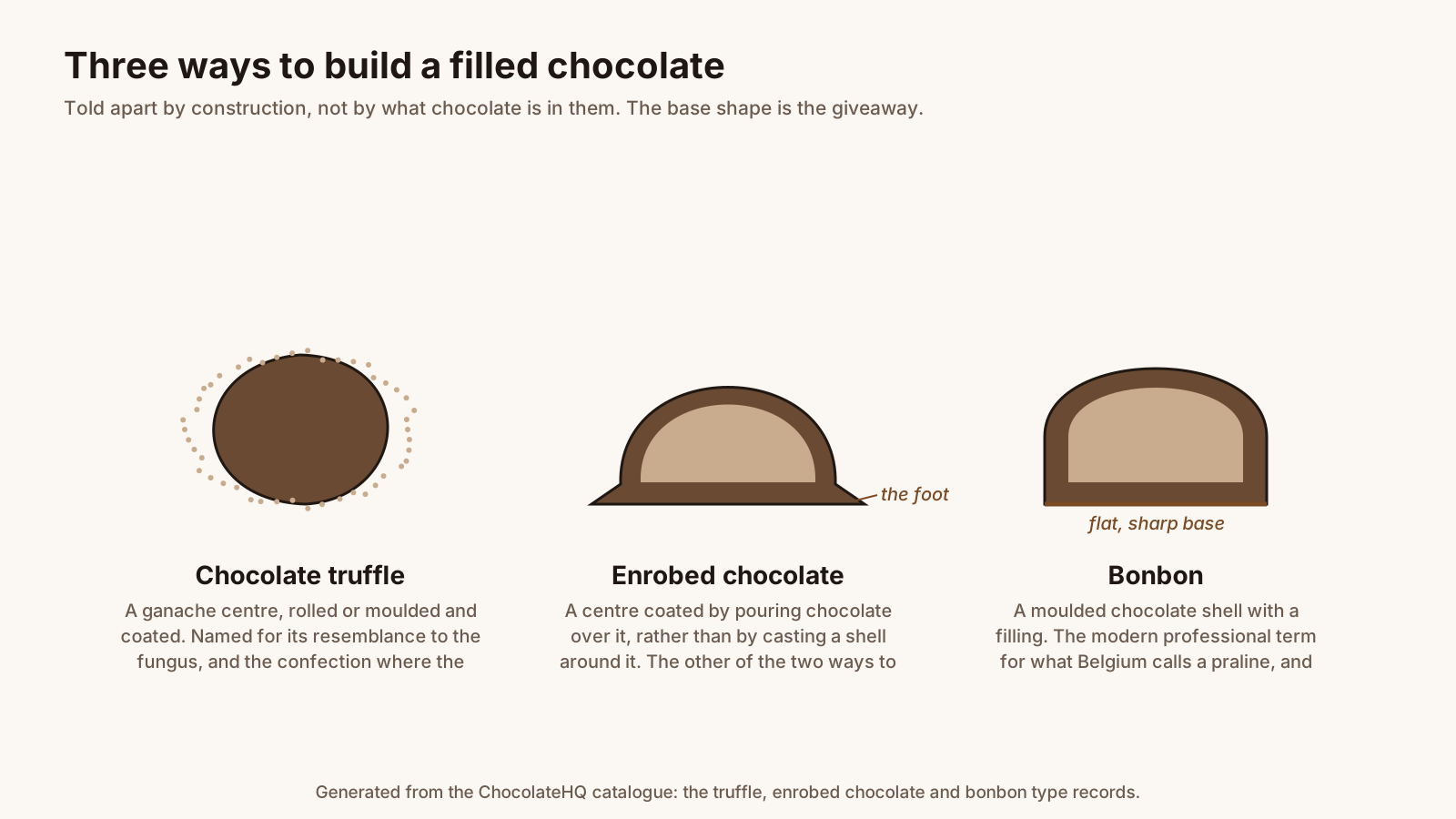
Defined by construction rather than by what the chocolate in them is. A truffle can be made from any composition, and several of these words mean different things in different countries.
A ganache centre, rolled or moulded and coated. Named for its resemblance to the fungus, and the confection where the ratio does more work than the recipe.
Praline
Contested categoryThree genuinely different products share this word in Belgium, France and the American South. Nothing about the term is reliable without knowing which tradition is speaking.
A moulded chocolate shell with a filling. The modern professional term for what Belgium calls a praline, and the piece that most tests a maker's tempering.
Any chocolate with a distinct centre. Regulated in the EU to the extent that the coating must actually be chocolate and must make up a stated share of the whole.
A centre coated by pouring chocolate over it, rather than by casting a shell around it. The other of the two ways to make a filled piece, and the one that leaves a foot.
Chocolate cast into a shape and allowed to contract out of it. Everything from a bar to a hollow Easter figure, and the technique that makes tempering visible.
Chocolate with gas bubbles set into it. The aeration changes how fast it melts, which changes how the flavour arrives.
Tempered chocolate spread thin, scattered with inclusions and broken up. The most forgiving confection there is, and the best first project.
A disc of tempered chocolate topped with nuts and dried fruit. French, medieval in origin, and the easiest professional-looking confection to make.
A centre built up in successive chocolate layers in a rotating pan. Slow, specialised, and the reason chocolate-covered almonds are perfectly round.
A moulded shell with nothing inside. Technically the most demanding moulding job, because the shell must survive handling and still be pleasant to eat.
Fresh or dried fruit coated in tempered chocolate. With fresh fruit it is a same-day product, and the reason is water.
A cooked-sugar centre in a chocolate shell. Keeps far longer than a ganache, which is why it dominates boxed selections.
A sugar confection with chocolate in it, and one where the texture is controlled by sugar crystal size rather than by the chocolate.
A spooned mound of chocolate and inclusions. Bark in individual portions, and the most forgiving confection there is.
A refrigerated ganache slab cut into dusted cubes. One of the very few confection names anywhere that carries a compositional definition on its home market.
Dubai-style filled chocolate
Not regulatedA thick moulded bar filled with pistachio cream and toasted shredded pastry. A trend product with a traceable 2021 origin, not a traditional confection.
Sourcing claims — where it came from and who made it
None is regulated, none is audited, and none says anything about what is in the bar. They answer questions about the supply chain.
Single-origin chocolate
Not regulatedA sourcing claim, not a composition or a quality standard. It tells you where the beans came from and nothing about how good they were.
Bean-to-bar chocolate
Not regulatedA claim about who did the manufacturing, not about the recipe. The maker roasts, grinds and refines the beans themselves rather than buying finished chocolate.
Craft chocolate
Not regulatedA sector rather than a specification. Unregulated, unaudited, and useful mainly as a signal of what a maker is trying to do rather than of what they achieved.
Single-estate chocolate
Not regulatedA far more precise sourcing claim than single-origin: one named property rather than one country. The precision is the whole value.
Tree-to-bar chocolate
Not regulatedOne step further than bean-to-bar: the maker grows the cacao as well as manufacturing it. Rare, and mostly found in producing countries.
Direct trade chocolate
Not regulatedA claim that the maker buys from growers without intermediaries. Unlike certification schemes it has no standard, no auditor and no mark — it is a description of a relationship.
The overwhelming majority of chocolate made, and the category craft writing defines itself against rather than describes.
Chocolate from beans of more than one origin, combined deliberately. A skill rather than a failure to specify.
Micro-batch chocolate
Not regulatedChocolate made in very small quantities, often from a single fermentation lot. Unregulated, and the constraint it describes is real.
Artisan chocolate
Not regulatedThe least defined word in the domain. It usually means a chocolatier working by hand — which frequently means remoulding somebody else's chocolate.
Product formats — what it is sold as
Shelf positions rather than compositions, and several of these cover more than one genuinely different product.
Baking chocolate
50–100%A product format covering several different things, which is why substituting one for another so often goes wrong.
A product format spanning two genuinely different drinks: melted chocolate in liquid, and cocoa powder in liquid. They are not versions of the same thing.
The default format, and a nineteenth-century industrial invention rather than an obvious way to eat chocolate.
Cocoa powder pre-blended with sugar, milk powder and dispersing agents. Mostly sugar, and a different product from drinking chocolate.
A soft chocolate-flavoured paste, kept spreadable by vegetable oil and sugar. Descended from gianduja, and generally much further from it than the packaging implies.
A commercial category rather than a product one — and a substantial share of annual chocolate sales concentrated into a few weeks.
Small moulded discs sold for eating rather than for melting — and easily confused with the callets that look identical.
A hollow chocolate sphere filled with cocoa and marshmallow that opens when hot milk is poured over it. A modern format, and a demanding one to make.
Couverture sold as a solid mass rather than as callets. Cheaper per kilogram, harder to melt evenly.
The European term for a moulded bar, and in Mesoamerican usage something quite different — a pressed disc of ground cacao for drinking.
An assortment of filled pieces, and the format where shelf life dictates what can be in it.
Cooking chocolate
40–70%A British and Australian shelf category, generally an ordinary sweetened dark chocolate of undistinguished quality sold for the kitchen.
Flat discs of couverture, sold in bulk for melting. Distinct from callets in shape and from buttons in purpose, and the format most professional recipes assume.
Bought-in empty shells for filling. A component rather than a confection, and the single largest shortcut in small-scale chocolate work.
Cocoa already dispersed in sugar syrup, which is the entire product. It exists because cocoa powder will not wet in cold milk and syrup will, and it is mostly sugar by weight.
A malt-led drink powder with cocoa in a supporting role. The malting and drying generate the same browning chemistry that roasting generates in cocoa, which is why the two taste like one flavour rather than two.