Making chocolate
A cacao bean fresh from the pod tastes of almost nothing anyone would recognise. Chocolate flavour is built, not revealed — and most of the building happens before the beans leave the farm.
The thing most accounts get backwards
Consumer writing treats the bean’s origin as the source of flavour and processing as something done to it afterwards. The chemistry runs the other way. Fermentation creates the precursors; roasting converts them; conching removes what is left over. A badly fermented bean of any pedigree makes bad chocolate, and no amount of skill downstream recovers it.
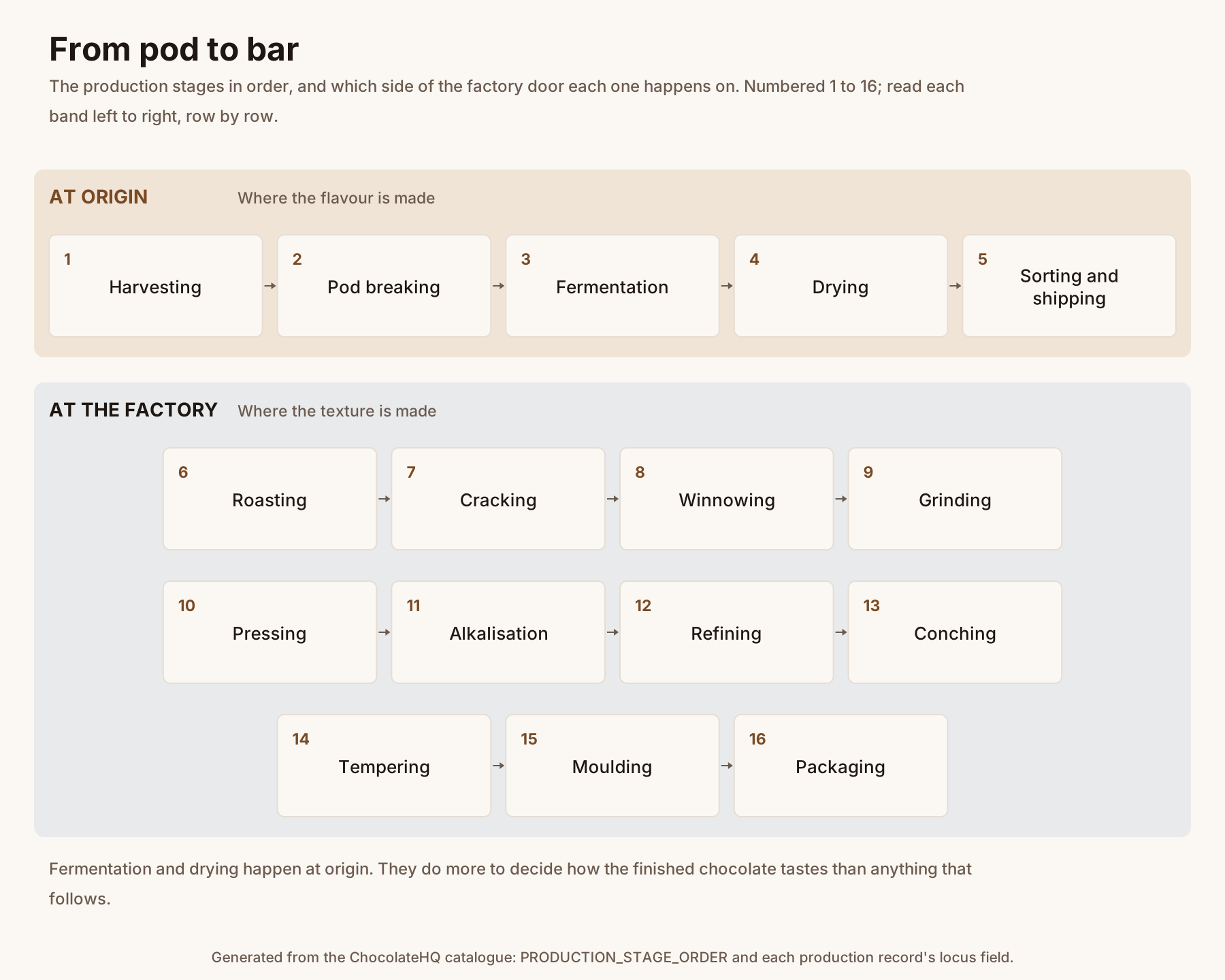
At origin
Performed on or near the farm, within days of harvest. These steps decide most of what the finished chocolate will taste like.
Harvesting
Cutting ripe pods from the trunk and branches by hand. Every pod is cut individually, and no mechanised alternative exists.
If it goes wrong: Mixed ripeness in a single fermentation batch. Under-ripe pods carry too little pulp sugar to drive the fermentation; over-ripe or germinated beans contribute off flavours. Both show up as flat, uneven flavour in the finished chocolate.
Judging which pods to cut. The first quality decision in the chain and the least discussed.
If it goes wrong: Mixed ripeness in one fermentation batch, giving a mix of under- and properly fermented beans in a single lot. Also germinated beans from pods left too long, which produce off flavours.
Deciding which pods to cut, on a tree carrying pods at every stage of development at once. It is the first quality decision in the chain and it is made by eye and by ear, tree by tree.
If it goes wrong: Harvesting the whole tree in one pass to save labour, mixing unripe and overripe pods. Overripe pods may also have begun germinating internally, and germinated beans are a recognised defect.
Pod breaking
Opening the pods and scooping out the beans with their surrounding pulp. The pulp is not waste — it is the fermentation's fuel.
If it goes wrong: Damaging the beans with the blade when splitting the pod. A cut bean ferments differently and can introduce mould into the batch.
Holding harvested pods unopened for several days before breaking. A deliberate technique, not a delay.
If it goes wrong: Holding too long, at which point pods deteriorate and mould or germination begin.
Fermentation
The step where chocolate flavour is created rather than developed. Skip it and no amount of roasting will produce chocolate.
If it goes wrong: Under-fermentation leaves the bean purple inside, bitter and astringent, with a flat 'raw' quality no roast will fix. Over-fermentation produces ammoniacal, hammy or putrid notes. Both are common, and under-fermentation is the more common of the two because it costs less time.
Beans piled on the ground under leaves. The traditional West African method, workable at smallholder scale with no equipment at all.
If it goes wrong: Uneven fermentation across the heap, giving a mix of under- and properly fermented beans in one lot. Too small a heap loses heat and may not reach fermentation temperature at all.
Wooden boxes with drainage, usually in a cascade so the mass can be turned from one into the next. The standard for fine-flavour production.
If it goes wrong: Boxes too deep, leaving an under-aerated core; or turning too early, which cuts the yeast phase short before enough ethanol has been produced.
Introducing oxygen at the right moment. The main lever a fermentary operator has, and where most of the skill sits.
If it goes wrong: Turning too early, cutting the yeast phase short; or not turning enough, leaving an under-aerated core that ferments incompletely.
The four ways a fermentation goes wrong, what each tastes like, and why under-fermentation is by far the most common.
If it goes wrong: Under-fermentation, and it is an economic outcome rather than a technical one — the incentive to ferment properly depends on whether grading rewards it.
Fermenting volumes too small to fill a box. Necessary for single-farm lots and harder than it looks.
If it goes wrong: Failing to reach or hold fermentation temperature, producing an under-fermented lot regardless of how carefully everything else was done.
Drying
- 12
Drying
Bringing the beans down to a storable moisture content, slowly enough to let the acid escape and the enzymatic reactions finish.
If it goes wrong: Forced drying that seals the bean and traps acetic acid — the finished chocolate tastes sharply sour and vinegary. Alternatively, slow drying in humid conditions allowing mould, which produces musty notes that carry all the way through. Smoke taint from drying over wood fires is a third, and is unmistakable in the cup.
Drying on raised beds, patios or drying tables over about a week. Slow enough to let the fermentation's acid escape, and entirely at the mercy of the weather.
If it goes wrong: Rain during the drying window, which stalls the process and allows mould; and drying too fast on a hot patio, which case-hardens the bean and traps acid inside.
Mechanical or wood-fired drying where the weather will not allow sun drying. Necessary in several producing regions, and the source of two of chocolate's most recognisable faults.
If it goes wrong: Case hardening, which traps acetic acid and gives sharp vinegary chocolate; and smoke taint from directly fired dryers, which is unmistakable and unremovable.
Case hardening, mould and smoke — three faults from one step, and all of them survive everything downstream.
If it goes wrong: Case hardening from excessive heat, mould from slow drying or damp storage, and smoke from direct firing.
A covered structure using solar gain with ventilation. The main technical answer to wet-season harvests.
If it goes wrong: Inadequate ventilation, which raises humidity inside the tunnel and stalls drying as effectively as rain would.
Sorting and shipping
The months between a dried bean and a factory. Grading decides what a farmer is paid, and storage decides whether the crop survives the journey.
If it goes wrong: Moisture reabsorption in storage or transit, producing mould and musty flavours; and infestation, which is a real problem in warm humid warehousing.
The cut test, the bean count and the defect percentage. This is where fermentation care is rewarded, or is not.
If it goes wrong: Grading applied loosely or not at all, which removes the incentive to ferment properly and is a supply-chain failure rather than a farming one.
Months in a warehouse and a container. Cacao is hygroscopic, and the risk is that it takes moisture back.
If it goes wrong: Moisture reabsorption from humid storage or container condensation, producing mould and musty flavours that no downstream step removes.
At the factory
Performed by the chocolate maker, usually thousands of miles and several months later. After grinding the chain forks: cocoa mass either goes forward into chocolate, or is pressed and milled into cocoa powder.
Sorting and shipping
Removing everything that arrived with the beans but is not a bean — stones, string, metal, dust, twigs, jute fibre and flat or broken beans — before anything is roasted.
If it goes wrong: Cleaning by size alone. A stone and a bean of the same diameter pass the same screen, which is why density separation is a separate operation rather than a refinement of sieving.
Roasting
- 21
Roasting
Where the precursors created by fermentation are converted into chocolate flavour, through the Maillard reaction. The first step that happens in the factory.
If it goes wrong: Over-roasting, which produces a flat, burnt, generic cocoa flavour and is frequently used deliberately to hide fermentation problems — a dark roast is the cheapest way to make a mediocre bean taste consistent.
The time-temperature curve rather than a single figure. Two roasts reaching the same temperature can produce very different chocolate.
If it goes wrong: A profile chosen once and applied to every lot, which suits industrial consistency and wastes a distinctive bean.
Preserving fruit, floral and acid character at the cost of leaving fermentation faults exposed.
If it goes wrong: Under-development, leaving a raw, sour, vegetal quality — a light roast is not the same as an insufficient one.
Building uniform, recognisable cocoa character — and flattening whatever the beans arrived with, faults included.
If it goes wrong: Going past development into pyrolysis, producing acrid, ashy burnt character.
Winnowing before roasting rather than after. More even heat, finer control, and a harder winnow.
If it goes wrong: Scorching, which happens faster than with whole beans because there is no shell buffering the heat.
Cracking
- 26
Cracking
Breaking the bean into pieces large enough to separate from the shell. Crack too fine and the winnower cannot tell nib from shell.
If it goes wrong: Cracking too fine, which produces nib fines that blow away with the shell and shell fines that stay in the nib. Both reduce yield and quality at once.
Winnowing
Cracking the beans and separating the shell from the nib by air. Mechanical, not chemical.
If it goes wrong: Shell carried through into the nib, producing a slightly gritty, papery character in the finished bar.
Grinding
- 28
Grinding
Milling the nibs until the friction releases their fat and the solid turns liquid. The result is cocoa mass — chocolate liquor — and it contains no alcohol.
Granite wheels on a granite bed, running for a day or more. Grinds, refines and conches at once, which is why small makers use one machine.
If it goes wrong: Stopping too early, leaving particle size above the perception threshold — the most common flaw in small-batch chocolate.
Pressing
- 30
Pressing
Squeezing cocoa butter out of chocolate liquor, leaving a solid cake that becomes cocoa powder. The step that created the entire cocoa and confectionery industry.
If it goes wrong: Over-pressing produces a very low-fat cake that gives a thin, dusty drink and a dry bake. It is a cost decision rather than an error, and it is invisible on most consumer packaging.
Alkalisation
Treating cocoa with an alkali to raise its pH. Darker, smoother, more soluble — and substantially lower in flavanols.
If it goes wrong: Over-alkalisation, which produces a flat, slightly soapy flavour along with the very dark colour. Colour is frequently the commercial objective, and flavour is what pays for it.
Refining
- 32
Refining
Reducing the particle size below the threshold at which the tongue can detect grain — roughly 20 to 30 microns.
If it goes wrong: Under-refining, which gives a sandy or chalky mouthfeel. It is the most common single flaw in small-batch chocolate, because adequate refining takes considerably longer than it appears to.
Steel balls agitated in a chamber. Fast, industrial, and it separates refining from conching so each can be controlled.
If it goes wrong: Over-refining, which produces an unpleasantly sticky mouthfeel — particles far below the perception threshold increase surface area and viscosity without improving texture.
Passing chocolate between counter-rotating rollers at decreasing gaps. The industrial standard, and the most precise.
If it goes wrong: Refining too fine, which raises viscosity sharply and produces a claggy mouthfeel rather than a smoother one.
The threshold is around 25 microns, and going far below it makes chocolate worse rather than better.
If it goes wrong: Under-refining gives grit; over-refining gives excessive viscosity. Both are failures of the same control.
Conching
- 36
Conching
Prolonged agitation that drives off harsh volatiles and coats every particle in fat. The step that made modern chocolate smooth.
If it goes wrong: Over-conching, producing chocolate that is smooth, mild and anonymous. It is a common outcome when a maker is chasing texture and treats conche time as a quality that only increases.
The first conching phase, run at low fat content. This is where volatile acids actually leave.
If it goes wrong: Too short, leaving a sharp, sour chocolate that later phases cannot correct.
The second phase, after the remaining cocoa butter and lecithin go in. This is where flow is built.
If it goes wrong: Adding lecithin too early, which coats particles before the dry phase has removed the volatiles it needed to.
Tempering
Controlling which crystal form the cocoa butter sets in. The reason chocolate snaps, shines, and releases from a mould.
If it goes wrong: Streaky, dull, soft chocolate that will not release from the mould and blooms within days — all of which are the same fault, an incorrect crystal form, presenting differently.
A continuous tempering unit holding the curve automatically. Standard at any production scale.
If it goes wrong: Over-crystallisation during a long run, which thickens the chocolate progressively and eventually requires a full remelt.
Moulding
- 41
Moulding
Depositing tempered chocolate into moulds, vibrating out air, and cooling it at a controlled rate.
If it goes wrong: Air bubbles from insufficient vibration, and surface dullness or bloom from cooling too fast or in a humid environment.
Casting a thin shell, filling it and capping it. How every moulded bonbon is made, and where tempering is most visible.
If it goes wrong: Shells too thick, from chocolate that is too viscous or left too long before inversion — unpleasant to eat and expensive in material.
- 43
Enrobing
Passing centres under a curtain of tempered chocolate on a belt. The industrial alternative to shell moulding.
If it goes wrong: Cracking, from a cooling tunnel that is too cold or a centre that was chilled before coating.
Taking moulded chocolate from liquid to solid at a controlled rate, so that the crystal form established in tempering survives — and so the bar contracts enough to release itself from the mould.
If it goes wrong: Refrigerating moulded chocolate to speed it up. It cools the surface far faster than the interior, traps unstable crystal forms, and causes condensation when the chocolate is removed.
Packaging
The last step, and the one most likely to undo the previous fifteen. Chocolate absorbs odours, hates temperature swings and blooms when it is cold.
If it goes wrong: Fat bloom from warm or fluctuating storage; sugar bloom from refrigeration and condensation; and odour pickup from storage near aromatic goods.
The same chain at two scales, optimising for opposite things. Neither is a degraded version of the other.